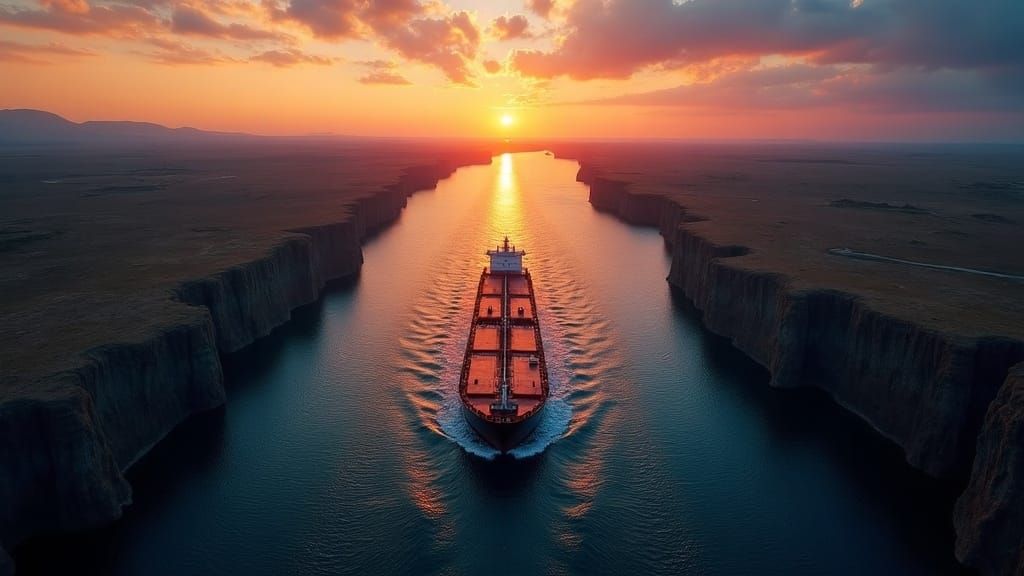
The closure of the Strait of Hormuz is rippling through energy and financial markets, driving repricing pressure across shipping, insurance, inflation and investment risk.
By Lara Sabri · Contributing Journalist · Reporting from Dubai
Located between Oman and Iran, the Strait of Hormuz is one of the world’s most important chokepoints — wide enough to accommodate the largest crude oil tankers, yet with few alternative routes if it were closed. Large volumes of oil flow through it every day, and the institutions that finance, insure and allocate around the Gulf are now being forced to price that concentration of risk directly.
Energy trade flows and marine traffic
Since February 28, regional escalation has impeded energy trade flows through the Strait, creating one of the largest supply disruptions in the history of the global oil market. Global gas markets have also been affected: about 20% of the world’s liquefied natural gas (LNG) passed through the Strait in 2025.
With marine traffic through the Strait of Hormuz declining by roughly 95%, Ellen R. Wald, author of Saudi, Inc. and president of Transversal Consulting, notes: “No crude oil, petroleum products, cargo or LNG can leave the Persian Gulf, and no ships can enter.”
“The economic consequences are significant,” Wald said. “Oil prices have risen and may increase significantly in the coming weeks as commercial stocks of crude oil, diesel and gasoline are depleted.”
Energy, agriculture and food fertilisers
Shipments of crude oil, gasoline, fuel oil, LPG, LNG, diesel, sulphur and ammonia have been reduced to near zero. Around 50% of the world’s traded sulphur originates in the Persian Gulf. “Sulphur and ammonia are key products needed for fertilisers,” Wald highlighted.
“Energy and agriculture are the most vulnerable to this prolonged bottleneck, because hydrocarbons are the primary products shipped out of the Persian Gulf via the Strait of Hormuz. This is already having significant impacts on agriculture across the world,” she added.
Parts of the Middle East, Africa, Asia-Pacific and Latin America face the added strain of higher food and fertiliser prices and tighter financial conditions. Low-income countries are especially at risk of food insecurity as assistance declines.
Risks and outcomes
The head of the International Monetary Fund warned that inflation was already picking up, and that the global economy could face a “much worse outcome” if the war in the Middle East drags on into 2027. Oil prices reached around $125 per barrel.
The IMF also warned that a longer disruption could weaken growth while pushing inflation higher through rising energy prices and tighter financial conditions.
Maritime security risks have intensified alongside the conflict. Navigation-signal interference has surged across Gulf shipping lanes, increasing operational uncertainty and collision risk. The disruption is adding to insurance costs and reinforcing concerns about the reliability of key trade routes.
“The risk of physical damage to vessels from IRGC mines, missiles, drones and boats remains elevated. Insurance companies will continue to price in the threat of closure or stoppage. Longer routes will be considered safer and potentially even cheaper as a result, altering shipping routes,” Wald stressed.
Financial strains
Beyond energy markets, the disruption is increasingly reflected in financial markets. Investors, lenders and insurers are reassessing risk in the Gulf, leading to higher borrowing costs, higher insurance premiums and a repricing of regional assets.
“Transit has been running at about 4% of normal — roughly four vessels a day, against a baseline near 95 — with both Hormuz and the Red Sea blocked at the same time,” said Nicholas Lubin, founding principal at Kade Technologies and the architect of KADE Intelligence Infrastructure.
“Gulf equities fell about 1.3% in May while world markets rose around 5% on the AI rally. The region has decoupled from global risk appetite, and capital is being made to price Gulf-specific risk on its own terms.”
The economic effects extend beyond fuel prices. Higher shipping and insurance costs can take longer to filter through supply chains, raising the price of goods even after energy markets stabilise.
“War-risk cover for tankers is pricing at roughly eight times pre-crisis levels, with several P&I clubs withdrawing entirely — which is starting to look more like a withdrawal of insurability than a repricing of it,” Lubin said.
“Energy is already feeding a fresh wave of fuel-price inflation. War-risk at eight times and both corridors shut is a shipping-cost shock that works through goods prices over months, not weeks — and it keeps feeding even if the oil price stabilises.”
Lubin argues the consequences may outlast the conflict itself, shaping how global investors allocate capital and assess exposure to the Gulf.
“The inward turn of Gulf capital was already underway before the war. The war doesn’t create that reorientation — it accelerates it. For allocators outside the region, the consequence is that the Gulf’s role as a swing supplier of liquidity into Western assets is being repriced.”
— Nicholas Lubin, Kade Technologies

Dubai-based contributing journalist at Universal Asset Owners, reporting on Gulf capital, energy and institutional risk. Full profile →
This article quotes named, on-the-record sources; figures and quotations are presented as provided by those sources and in public statements. Universal Asset Owners labels reported features and discloses material relationships relevant to coverage.